Homestead Herbs & Healing | holistic living
  • Start Here
  • Homestead
  • Herbs
  • Healing
  • Recipes
    • Breakfast
    • Main Course
    • Dessert
    • Snack
  • DIY
  • Minimalism
  • About Me

  reading time: 5 min


I call this one my Persephone cake.

Why?

When I told my friend this (he was one of my taste tester guinea pigs), he said: "Isn't she the wife of Hades?"

To which I replied: "Excuse me? I think you mean: Hades is the husband of Persephone." 😜

But yes, in Greek mythology, Persephone
was abducted by her uncle (!) Hades, the king of the underworld, and forced to marry him (yuck!), making her the queen of the underworld. Persephone is the daughter of Zeus, the king of the gods, and Demeter, the goddess of harvest and fertility – who is also Zeus’ sister (yay to the good old incest times!).

Persephone – also known by the name Kore or Cora which translates to "maiden" or "daughter" –
is the goddess of death and life, destruction and fertility. Her equivalent in Roman mythology is the goddess Proserpina or Proserpine.

The pomegranate is to Persephone what the seashell is to Aphrodite. Well, kind of.

For once because in Greek mythology she eats six pomegranate seeds from Hades in the underworld
, which forces her to stay in his realm. And furthermore, the pomegranate is a symbol of life and fertility, but also of power (like a royal orb), prosperity, blood and death. In Ancient Greek mythology, the pomegranate was known as the "fruit of the dead".

Which – finally – brings me to this cake.

A dark, moody chocolate cake with a hint of rosemary sprinkled with pomegranate seeds.
By the way, Aphrodite is also associated with pomegranates 'cause seeds = fertility / sexuality. And you know what else is associated with pomegranates? Samhain.

The Day of the Dead, also known as All Hallow's Eve, or Halloween. The Witches' New Year, rebirth after death. (It's all coming full circle, see? 😅)


Persephone depicted in Dante Gabriel Rossetti's "Proserpine" (1874)


Some of the traditional correspondences for Samhain include pomegranates, nuts – and rosemary. Which is why I decided to combine all three in this tart. In my book, dark chocolate also fits the moody vibe of Samhain perfectly 🖤

So yeah, this vegan chocolate rosemary & pomegranate tart is the perfect dessert for a Samhain, Halloween or even Christmas party! Any holiday during the dark half of the year will do :)

The crumbly chocolate crust is filled with a rich rosemary-infused chocolate pudding, and adorned with fresh pomegranate seeds, nuts, and chocolate shavings.

Enjoy!

VEGAN CHOCOLATE ROSEMARY & POMEGRANATE TART

Preparation time: 2 hours
Main ingredients: whole grain flour, soy milk, chocolate
difficulty level: easy
serves: 14 (1 tart)
suitable for: vegan, lactose-free, wheat-free, yeast-free

Ingredients

Crust:
200 g whole grain spelt flour
50 g ground hazelnuts or almonds
50 g raw cane sugar or brown sugar
115 g melted vegan butter or coconut oil
2-3 tbsp unsweetened cacao powder
1/4 tsp nutmeg
1/2 tsp cinnamon

a pinch of salt

Filling:
400 ml soy milk
3 sprigs fresh rosemary
125 ml coconut milk
1 package (35 g) chocolate pudding powder (we use the Dr. Oetker chocolate pudding powder)
75 g sugar
200 g high-quality dark vegan chocolate, broken into pieces (I use 70 %)
1 tsp vanilla extract

also:
1 cup pomegranate seeds
chopped hazelnuts or almonds
grated dark chocolate


Instructions

Grease and flour a tart pan or springform pan. Preheat oven to 180 °C / 350 °F.

For the tart crust:

In a medium bowl, combine whole grain spelt flour, ground hazelnuts or almonds, cocoa powder, sugar, cinnamon, nutmeg, and salt.

Lastly, add melted vegan butter or coconut oil, and combine until everything comes together into a crumbly dough.

Form into a ball, wrap in clingfilm or wax paper, and set aside for 30 minutes in the fridge.

Once chilled, remove dough from its wrapping and roll out on a floured surface. Line the tart pan or spingform pan, making sure the edges are raised to form a rim that will be able to hold the filling (about 4 cm / 1.5 inches high). Trim any excess, and prick all over with a fork.

Blind-bake the tart crust in the preheated oven for about 15 minutes, placing a similar-sized blind weight on top to prevent rising. Remove the weight, and cook for another 10 to 15 minutes, or until cooked through.

Remove the tart crust from the oven, and allow to cool.

For the rosemary-infused milk:

Place 3 sprigs of fresh rosemary in 400 ml soy milk. Set aside for later.

In the meantime, prepare the filling.

For the filling:

In a heatproof bowl set over a small saucepan of gently simmering water, melt the chocolate pieces over low heat, stirring constantly. Once melted, remove from heat.

To make the chocolate pudding, stir together the pudding powder and sugar with a few tablespoons of the rosemary-infused soy milk until dissolved. Bring the rest of the rosemary-infused soy milk to a gentle boil (leaving the sprigs in the milk for now!), along with the coconut milk.

Once it starts boiling, carefully remove the rosemary sprigs with a fork. Quickly stir in the pudding powder mixture using a whisk, until there are no more lumps. Bring to a brief boil again over medium heat, while constantly stirring.

Do this for 1-2 minutes until the mixture starts to thicken. Remove from heat.

Add melted chocolate and vanilla essence to the pudding, and stir once again.

To assemble:

Generously sprinkle pomegranate seeds all over the cooled tart crust.

Pour the warm and still-liquid chocolate pudding mixture on top, and spread evenly using a spatula. Set aside until cooled completely. I recommend transferring it to the fridge after about 30 minutes.

Once cooled, feel free to decorate the chocolate tart with pomegranate seeds, chopped nuts, and shaved chocolate.

Store refrigerated until serving.

I recommend adding a dollop of fresh (vegan) whipped cream on each slice when serving!


TIPS & NOTES:
- To enhance the delicate pomegranate flavour, you could replace part of the soy milk with pomegranate juice (or even red wine!).
- If you don't like the taste of rosemary, you could substitute it with fresh mint leaves.
- Instead of pomegranates, raspberries would also go nicely with this tart. (Not a Persephone cake then, though ;-))


Looking for more chocolaty dessert recipes? Here are some of my favourites:

Vegan Snow White Cake (Donauwelle)
Vegan Dark Chocolate & Red Wine Cake
Vegan Black Forest Cake (Schwarzwälder Kirschtorte)
Vegan Dark Chocolate & Cherry Brownies


♥

Maisy

 reading time: 3 min


They had eaten beer potage, thick with croutons and cheese, and Ciri had been surprised they had not served mushrooms as well. They had drunk cider, but the girl had been given water and was clearly both astonished and revolted by it.
»Where's the salad?« she had yelled, and Lambert had rebuked her sharply and ordered her to take her
elbows off the table.
Mushrooms and salad. In December? 

Blood of Elves, Andrzej Sapkowski


In chapter 2 of the first book of the Witcher saga written by Andrzej Sapkowski, Blood of Elves,
the princess of Cintra, Cirilla Fiona Elen Riannon, better known as Ciri, is trained at an old witcher's keep called Kaer Morhen by Geralt and other witchers. During her time there, the sorceress Triss Merigold comes to Kaer Morhen, and together they enjoy a meal – beer potage, a soup "thick with croutons and cheese".

Today, we are making a vegan version of said soup!


Ciri is outraged at the lack of mushrooms and salad in this meal. (source)


Beer potage – or beer soup – refers to a roux-based soup made with beer. In medieval Europe, it was served poured over bread as a breakfast soup, served with cider – and no mushrooms.

Personally I'm not a big fan of alcohol – indeed, I try to take in as little as possible, because I don't like the taste and I definitely don't like the intoxicating effect on health –, but every now and then I will use a bit of wine or even liquor in meals such as my scrumptious vegan Dark Chocolate Red Wine Cake
or my vegan Bilbo's Seed Cakes. So today we have my first ever recipe on my blog that features beer.
 
This beer soup is rich, thick, creamy, and cheesy, and incredibly easy to prepare. I recommend pairing it with crunchy croutons and freshly squeezed lemon juice which balances out the heaviness of the cheese.

   reading time: 4 min


Onion cake, or Zwiebelkuchen, is a German savoury "cake" or tart that is similar to pizza and quiche, and traditionally made with loads of onions, diced bacon, cream, and caraway seeds on a yeast dough. For my vegan version, I am using smoked tofu, soy creamer, and vegan sour cream.

It's hearty, it's moist, and it's super good! It's one of my favourite dishes in autumn and winter, but you definitely need to like onions for this one :) Also, I recommend not skipping on the cumin, as this is what will help you digest the "windy" onions and leek.

TIP: The dough can also be made a day in advance and can be kept in the refrigerator before proceeding with the recipe. That way you don't have to spend as much time in the kitchen the next day when preparing the filling and baking the onion cake for lunch or dinner.


VEGAN ONION CAKE

Preparation time: 2 hours
Main ingredients: onions, flour, soy creamer, smoked tofu, yeast
difficulty level: easy
serves: 8 (26 cm- or 10-inch springform pan)
suitable for: vegan, lactose-free, wheat-free, nut-free

Ingredients:

crust:
300 g spelt flour (type 1050) *

1/2 tsp salt
80 g vegan margarine or vegetable oil
1/2 cube (20 g) fresh yeast
1 tsp sugar
125 ml lukewarm water


filling:
2 tbsp vegan butter, vegetable oil or vegan lard (I use German Apfel-Zwiebel-Schmalz)
800 g white onions, chopped
1 leek, chopped
125 g smoked tofu, diced
200 ml soy creamer
150 g vegan sour cream or creme fraiche (I use the German brand Creme Vega by Oetker)
1 tsp cornstarch
1 tsp cumin or caraway
1/2 to 1 tsp sea salt, or to taste (a bit of smoked salt works great too)
black pepper, to taste

pinch of nutmeg
(optional) pinch of kala namak black salt (for that eggy taste)


* If you are confused about that flour type, check out this website which explains the difference between German flour types and US-American flour types.  


Instructions:

Lightly grease and flour a 26 cm- or 10-inch springform pan or baking tray.

For the crust:

Combine the yeast, sugar and water in a small bowl and let the yeast do her magic.

In a large mixing bowl, combine flour and salt. Mix to combine. Add vegan margarine or vegetable oil, and knead using
your clean hands or an electric mixer with a dough hook until a smooth, soft dough forms. The more you knead, the better the dough will be.

Form the dough into a ball and cover with a damp kitchen towel or a plate. Let rest in a warm spot for 1 hour.

If you are preparing the dough a day in advance, store the dough overnight in the fridge instead, then continue with the recipe the next day, giving the dough a chance to come to room temperature while you prepare the filling.

While the dough is proofing, prepare the filling.

For the filling:

To a large pan, heat 1 tbsp of
vegan butter, vegetable oil or vegan lard over medium heat. Add the diced smoked tofu, and cook until it is nice and crispy. Set aside.

In the same pan with the grease left from the tofu, add 1 tbsp of
vegan butter, vegetable oil or vegan lard, as well as cumin or caraway. Over medium heat, gently fry the seeds until they start to pop and release their aromatic fragrance, about 1 minute.

Then add the onions and leek. Turn down the heat to medium-low, place a lid over the pan, and sautée until soft and translucent. Remove from heat, and add the fried smoked tofu.

In a separate bowl, whisk together soy creamer, vegan sour cream, cornstarch, salt, pepper, and black pepper. Fold the mixture into the onion/leek/tofu mixture. Everything should be nicely combined.

Preheat oven to 180 °C / 350 °F.

Transfer the risen dough into the greased and floured pan, and roll it out. Make sure that the edges are raised to form a rim that will be able to hold the filling (about 5 cm / 2 inches high).

Pour the filling onto the dough and smooth it down with a spatula or the back of a spoon.

Bake the onion cake for 35–40 minutes in the preheated oven. Cover after 30 minutes if necessary so that the onions don't burn.

Serve right away, or enjoy cold.


TIPS:
- If you are looking for a drink to pair this with, o
nion cake is traditionally accompanied by new wine such as Federweißer, or a dry white wine such as a Riesling. 
- This onion cake is also great to take with you on the go.
- If you are a bit lazy like me, you can skip frying the smoked tofu and just add it to the cooked onion/leek mixture as is.
- Feel free to replace the yeast in this recipe with 20 g of sourdough starter. Make sure to prolong the rising time to about 2-4 hours, if possible, or allow the dough to proof overnight.
- If you are short on time, you can also use store-bought pizza dough – it won't taste as good as homemade yeast dough, but it's a quick and easy alternative.


Looking for some more sweet and savoury German recipes? Here are some I could eat every day:
 Rustic German Apple Cake (vegan)
 Homemade German Walnut Bread
Vegan Asparagus with Hollandaise Sauce and Potatoes


♥

Maisy

    reading time: 4 min


    With a flick of her wand, Queen sends raisins, apples and pastry flying into the air. The concoction neatly wraps itself up into a cylindrical pie, baking on the spot,complete with ornate decoration and a dusting of sugar.

    Fantastic Beasts and Where To Find Them, J. K. Rowling


My birthday always falls on Mabon, the autumn equinox and fruit harvest festival, with apples being one of the main fruits that are ripe for harvest around this time where I live (along with plums, pears, crabapple, rowan berries, and hawthorn berries).

So for my birthday this year I thought this apple strudel inspired by the version we see in the movie Fantastic Beasts and Where to Find Them was perfect to not only celebrate my birthday, but also the autumn equinox. And of course, for a magical Harry Potter party!

Tumblr: Image

»You prefer strudel, huh, honey?«

– Fantastic Beasts and Where to Find Them

Jacob Kowalski falls for the magic of Queenie's baking skills. (source)

Unfortunately, my apple roses didn't magically wrap and arrange themselves on top of the strudel, but I'm still pretty happy with how they turned out, given that they're basically just cooked apples that somehow ended up looking like marzipan roses.

To be honest, you don't need the apple roses (they don't taste like much), but if you feel like tinkering about to create pretty decorations for your strudel, go for it!

If you don't feel like adding the apple roses, I suggest cutting a few slits in-between the braids for a more interesting look.


QUEENIE'S VEGAN APPLE STRUDEL

Preparation time: 1 h 15 min
Main ingredients: puff pasty, apples, almonds, cinnamon
difficulty level: easy-moderate
serves: 4
suitable for: vegan, lactose-free, soy-free, yeast-free, low sodium

Ingredients:

2 sheets of store-bought puff pastry

strudel filling:
4 small to medium apples (e.g. gala or pink lady)
1 tbps lemon juice
1 tbsp maple syrup or agave syrup
1 tbsp raw cane sugar or brown sugar
1 tsp vanilla extract

1 tbsp cinnamon
1/4 tsp ground nutmeg
1/4 tsp ground cardamom
a pinch of salt

(optional) 1 tsp orange zest
(optional) 1 tbsp rum

1/4 cup almonds, chopped
a  handful of raisins

also:
non-dairy milk or melted vegan butter, for brushing the pastry
2 red apples
1 tbsp lemon juice
icing sugar, for dusting

Instructions:

Make the filling:

Start by preparing the filling. Rinse and chop apples into cubes.

To a medium-sized saucepan, add chopped apples and maple or agave syrup. Put on the lid, and bring to a simmer. Allow to simmer for about 5 minutes.

Remove the lid, and add remaining filling ingredients except for almonds and raisins: lemon juice, sugar, vanilla extract, cinnamon, nutmeg, cardamom, salt. Also add orange zest and rum if using.

Allow to simmer (without the lid) for another 5 minutes, or until the apples are starting to get nice and soft.

Remove from heat, and allow to cool completely. If there's still a lot of liquid, don't worry about it.


Make the apple roses:

(I do this while the strudel bakes, but you can also do this beforehand.)

Cut 2 cored apples into paper-thin slices, using your best knife or a mandolin. Leave the skin on for the pretty red rim.

Place apple slices into a heat-safe bowl, along with 1 tbsp of lemon juice. Pour boiling water on top, and leave to soak for about 3 minutes. Or use cold water, and microwave on high for 3 minutes.

Once the apple slices are soft and flexible, use a fork to lift out one slice at a time. Lay a couple of slices on top of each other, overlapping them about two-thirds, then roll them into an apple rose. Place into muffin cups so they will hold their shape.

Or arrange them directly in the muffin cups. Set aside.


Make the strudel:

Preheat oven to 200 °C / 390 °F.

Once the filling is fully cooled, stir in the raisins and chopped almonds.

Remove the puff pastry from the fridge. Cut one of the 2 sheets into 9 thin strips, and r
oll each strip into a more-or-less round ribbon. Take the first 3 ribbons, and braid them into a simple 3-strand braid. Repeat with the remaining ribbons. Set the three braids aside.

Roll out the other sheet of puff pastry to roughly the size of
12″ x 16″ or 30 x 40 cm. I do this on a sheet of baking paper.

Spoon the filling along the long side of the rolled puff pastry, keeping it about 1 inch or 2 cm away from the edge. Using the baking paper (or a tea towel), roll up the strudel with the seam side down. Slightly tuck in the ends.

To attach the braids, carefully wrap them around the strudel and tuck them under, once again using the baking paper or tea towel. (I had some braided pastry left, so I decided to add it as a fourth braid.)

Use a bit of non-dairy milk to stick the braids to the strudel.

Place strudel onto a baking sheet, and brush with non-dairy milk or melted butter.

Bake at 200 °C / 390 °F in the preheated oven for about 30-40 minutes, or until golden brown. Keep an eye on it to prevent it from getting too dark.

Remove from oven, and allow to cool.

Carefully place the apple roses on top of the strudel, and dust with powdered sugar.

Serve immediately with a bit of vegan vanilla ice cream, or whipped cream, if you like.


TIPS & NOTES:

- Without the apple roses, this strudel is super easy to make! Feel free to skip them, or make them from marzipan instead (you can also buy those). The braids are very easy to make, and they look amazing without the apple roses, too.
-
Instead of using store-bought puff pastry, you can also use filo / phyllo pastry, which is less airy and buttery flaky, and more crispy, I would say.


Looking for more nerdy recipes? Check out some of my other fiction-inspired creations:

Mrs. Weasley's Christmas Fudge (vegan)
Legolas' Lembas (vegan)
Sansa's Lemon Cakes (vegan)
Ezran's Jelly Tarts (vegan)


♥

Maisy


  reading time: 10 min


What is better than freshly baked, crusty, artisan sourdough bread?

HOMEMADE freshly baked, crusty, artisan sourdough bread
😜

And so the loaf affair continues ...

In 2020, our exciting experiment of the year was homebrewed kombucha (still love it till this day, although we usually take a break during the winter months), and in 2021 it was the year of foraging and preserving food – or rather the first year of actually implementing it.


For 2022 it was my goal to add something new to our kitchen habits, and that is making our own sourdough bread using our own sourdough starter from scratch!

So today I want to show you how I
make my easy artisan sourdough bread that is low in gluten, nutritious, and most important of all, delicious! With a lovely crust and an airy inside ("crumb"), yum!


The main character of this loaf story: a potent sourdough starter.

Beautiful rustic crust.


The Bread Baking Schedule:

OPTION 1 – afternoon bread (how I usually do it)

DAY 1 (Friday):

NIGHT: An hour before going to bed, at around 10 p.m., I begin my dough by building the levain. I cover the bowl with a wet tea towel and a plate on top, and set it aside at warm room temperature to do its magic overnight. Then I head off to bed.

DAY 2 (Saturday):

MORNING: As soon as I get up, say 9 a.m., 'cause it's the weekend, I take my bubbly levain and mix it levain with the remaining ingredients to make the main dough. I let it hydrate for 30 minutes, then start stretching-and-folding my dough every 30 minutes for a total of 4 times, so 2 hours.

MID-MORNING: At around 11:30 a.m. my dough is ready to bulk ferment for another hour or two, covered once again with the wet cloth (and plate).

NOON: At around 1 p.m. I shape the bulk fermented dough into a loaf. I place the loaf in a proofing basket, and set aside to proof for another hour. In the meantime, I preheat the oven for 1 hour.

I then bake the bread, and at about 3 p.m. it's ready!


OPTION 2 – bread for breakfast

DAY 1 (Saturday):

11 a.m. Build levain. Cover and set aside at room temperature for 4 hours.
3 p.m. Mix main dough. Cover with wet cloth.
3:30 p.m. Stretch-and-fold dough every 30 minutes, 4 times in total.
5:30 p.m. Bulk ferment for 3 hours, covered with wet cloth.
8:30 p.m. Shape loaf. Place in proofing basket at room temperature, covered with wet cloth.
9 p.m. Place basket in the refrigerator to proof overnight. (Sleep well, little loaf!)

DAY 2 (Sunday):

9 a.m. Take loaf out of the fridge. Preheat oven for 1 hour.
10 a.m. Bake bread.
11 a.m. Enjoy oven-fresh bread for a late breakfast or brunch. (If you want to eat breakfast earlier, you'll just need to get up earlier 😉)


OPTION 3 – bread for dinner

DAY 1 (Monday):

6 p.m. Build levain. Cover and set aside at room temperature for 4 hours.
10 p.m. Mix main dough. Cover with wet cloth.
10:15 p.m. Stretch-and-fold dough every 15 minutes, 4 times in total.
11 p.m. Bulk ferment in the refrigerator overnight, covered with wet cloth and a plate on top. (Sweet dreams, sourdough!)

DAY 2 (Tuesday):

7 a.m. Shape loaf. Put proofing basket in the refrigerator, covered with wet cloth and plate.
5 p.m. Take proofing basket out of the fridge, uncover and set aside at room temperature for 1 hour to warm up. Preheat oven for 1 hour.
6 p.m. Bake bread.
7 p.m. Enjoy oven-warm bread for dinner!


All of these different stages of baking and terms like starter, discard, levain, bulk fermentation, banneton, lame, dutch oven, crumb etc. can seem overwhelming. But don't worry about getting everything "right" the first time. Trust the process! Once you get the hang of it, it's really not that complicated, and most of the time is inactive waiting, with only a couple of minutes of actual work 😊
 

 reading time: 4 min


  (...) there they rested for a while and had such a breakfast as they could, chiefly cram and water. (If you want to know what cram is, I can only say that I don't know the recipe; but it is biscuitish, keeps good indefinitely, is supposed to be sustaining, and is certainly not entertaining, being in fact very uninteresting except as a chewing exercise. It was made by the Lake-men for long journeys).

The Hobbit, J.R.R. Tolkien


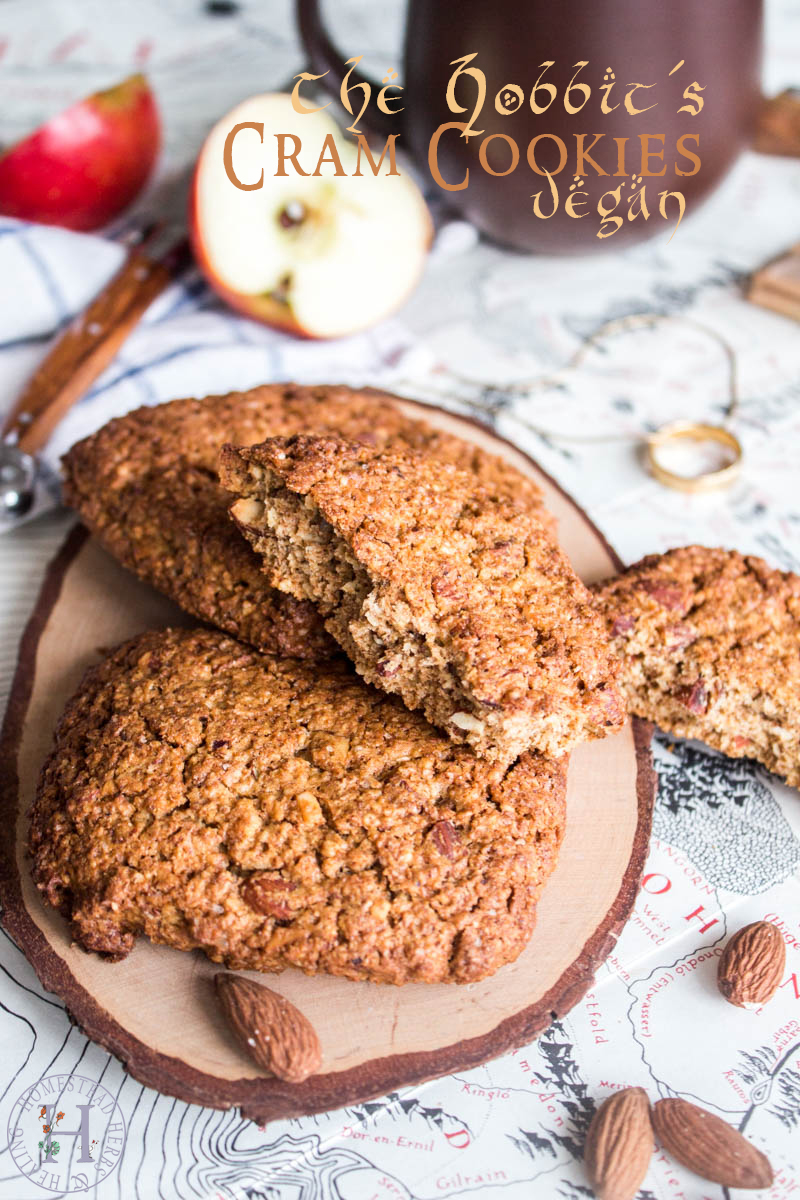
Today is "Hobbit Day", and in honour of our fur-footed friends we are going to make cram cookies.

Apparently, cram is as tasty as it sounds – which is not very tasty! It is said to be of biscuit-like substance, nutritious (since they were used as sustenance on long journeys) and, well, pretty much flavourless. Kind of like hardtrack which is a biscuit made of flour, water and sometimes salt, that lasts for months, is hard and dry, and commonly used for long sea voyages or as military ration.

It doesn't sound very enjoyable, to say the least. But of course, Hobbits are fond of anything edible – and in The Hobbit the dwarves and Bilbo eat cram to sustain them on their journey to the Lonely Mountain. (I've always identified as a Hobbit – or a halfling: small, squarish, with dark blonde curly hair and a preference for a simple life, sitting in an armchair, gardening, reading and eating, that sort of thing, lol.)

Bilbo and the dwarves are ready to munch on some cram after a long unexpected journey. (source)


As we learn in The Fellowship of the Ring, when Gimli tastes Lembas for the very first time, cram is similar to the Elvish "waybread", though much less pleasant and not quite as filling.

But don't fret: My take on these "press cakes" is way more tasty than their flavourless and uninspiring original!
They are more like firm crumbly cookies that are very snack-friendly and great for hiking or long roadtrips.

Speaking of hiking, if you ever need a cheery hiking song, definitely check out the Hobbit Drinking Medley by Peter Hollens feat. Hank Green if you don't know it already – it's one of my favourite nerdy collabs of all time!


But back to the biscuits.

I based my cram recipe on the Italian almond biscuits biscotti, which – as I mentioned in my Beorn's honey cakes last year – are possibly where Tolkien got his idea for the various twice-baked hardtracks. The Latin (panis) biscoctus literally means "(bread) twice-baked". I combined that with the English Hobnob oat cookies, which are actually called "Hobbits" here in Germany.

And there you have it! My very own cram cookies. I'm sure Bilbo would take a bite at once.

By the way, how do you like my One Ring? It's actually my Dad's wedding ring, haha!

 reading time: 4 min


Until recently I always associated homesteading with owning a large piece of land, growing your own food, owning farm animals like chickens, goats, cows etc., and basically being self-sufficient. However, when looking at the term "homestead", none of that is actually needed in order to call yourself a homesteader, or to participate in a homesteading lifestyle. According to Merriam-Webster, it means no more than "the home and adjoining land occupied by a family", and, according to Wikipedia, "is characterized by subsistence agriculture, home preservation of food, and may also involve the small scale production of textiles, clothing, and craft work for household use or sale."

In fact, it does not even matter whether you own a "home and adjoining land". What matters is your lifestyle.

So here are some – smaller and bigger – ways to homestead that don't depend on having a farm or a garden or even a permanent home! Some of the listed ideas do require a backyard or a balcony, but most of them don't.

I am definitely not saying that you need to do everything on this list in order to be "homesteading". Do what you can and what fits your personality, your preferences, and your lifestyle.

And who knows, perhaps you will – like me – find that you are already a homesteader after all!

If you want to know some of the ways that I myself practice homesteading, check out my blog post on
Why Homesteading? + Homesteading on a Small Scale.


KITCHEN

  • Eat seasonal foods
  • Cook from scratch
  • Buy locally (e. g. from local farmers)
  • Preserve foods (dry, can, pickle, freeze etc.)
  • Grow kitchen herbs indoor (e. g. mint, basil, parsley)
  • Make fermented foods
  • Make your own jams and chutneys
  • Make apple butter and apple sauce
  • Bake your own (sourdough) bread
  • Make kombucha at home
  • Make yogurt at home
  • Stock up your pantry for the winter months
  • Make your own broth from kitchen scraps
  • Compost your food scraps and garden waste
  • Make your own Bokashi fertilizer using food scraps (including cooked ones such as rice, pasta sauce etc!)
  • Start vermicomposting (great for kitchens or for balconies – can double as seating area)

GARDEN *

  • Grow kitchen herbs or medicinal herbs (e. g. mint, rosemary, dill, garlic mustard, garden sorrel, chamomile, calendula)
  • Grow your own vegetables (e. g. tomatoes, radishes, potatoes, beans, squash)
  • Learn to identify edible wild herbs in your garden (e. g. dandelion, nettle, ground elder, creeping charlie, plantain) 
  • Grow strawberries
  • Plant berry bushes and/or fruit trees (e. g. raspberries, blackberries, apple tree, peach tree)
  • Grow pollinator plants (e. g. calendula, lavender, cosmos, nasturtium, echinacea, chamomile)
  • Set up a compost for your food scraps and garden waste
  • Set up a worm bin for vermicomposting (also great for balconies or indoors)
  • Keep backyard chickens
  • Use a rainwater tank to water plants (this can also be done on a smaller scale on a balcony!)
  • Install a water pump
  • Install solar panels (again, also possible for a balcony)
  • Put up an insect hotel
  • Set up a watering station for bees and other insects
  • Set up a bird bath
  • Save seeds for future crops


    * If you don't have a garden, almost all of these things can be applied to a balcony or a roof terrace, using raised garden beds.


WARDROBE & BEAUTY

  • Sew your own clothes, pillow cases, lavender bags etc.
  • Mend your own clothes
  • Purchase clothes second hand
  • Choose practical clothes that fit your lifestyle (I prefer natural fabrics such as cotton, wool or linen)
  • Make your own beauty and skincare products (such as lip balm, rose water or herbal hair rinse, which are all great for beginners)
  • Make your own toothpaste
  • Make your own sunscreen


OTHER

  • Focus on a slow, simple, joyful life
  • Do grounding activities (digging in the dirt, picking flowers from the garden, baking bread, cuddling your pets, going for nature walks, reading etc.)
  • Read books on homestead topics (permaculture, fermenting, beekeeping etc.)
  • Go to a pick-your-own farm
  • Go wildcrafting
  • Propagate your plants (and give away or sell)
  • Make your own pottery
  • Make your own candles
  • Make your own cleaning supplies
  • Make your own laundry detergent
  • Dry your clothes on a line or a drying rack
  • Make a campfire in the summer, and cook over the fire
  • Keep a first-aid kit (with homemade goodies)
  • Purchase plastic-free / unpackaged foods
  • Maintain, repair, install and build household objects
  • Reuse, recycle and repurpose items
  • Collect grey-water from your sink/bathtub/washing machine and re-use to flush the toilet
  • Purchase items second hand
  • Sell decluttered clothes and other items
  • Give away or sell homemade products (e. g. healing salve, hand soap, rose water, jam etc.)
  • Make homemade gifts for birthdays and holidays
  • Invite friends over and host a (homegrown) dinner
  • Volunteer / work on a nearby farm or orchard
  • Partake in community-supported agriculture (CSA) or cropsharing
  • Trade your skills/products for other skills/products (literally skill-sharing!)


What are small or big ways in which you are homesteading? Is there anything else I should add to this list?


♥

Maisy

 reading time: 2 min


I recently spotted a vegan copycat "chunky monkey" ice cream at our local supermarket which I had to take home with me of course, and I also had a few blackened bananas sitting in the fridge, so this chunky monkey banana bread was the only logical next step! 🐒

This recipe is of course based on the popular Ben & Jerry's ice cream flavour, and it's a vegan adaptation of Serene's chunky chocolate chip banana bread over on House of Yumm. It's moist, tender, with an intense banana-chocolate flavour and crunchy walnuts.

You can also substitute the walnuts with pecans or peanuts, but it wouldn't officially be a chunky monkey banana bread then 😉

So if you have any overripe bananas lying around in your kitchen, don't throw them away – save them for this delicious nutty chocolaty banana bread!!

Honestly, this might be the BEST banana bread I've ever made (except for the "best banana bread" of course which is sugar-free and equally amazing)! But see for yourself.


 reading time: 3 min


It's officially pumpkin season here in Germany! Carved pumpkins; pumpkin spice lattes; pumpkin pies; pumpkin soups; and, of course, pumpkin bread – I love them all.

This recipe uses yeast, so you could say it's a German-American hybrid. It's definitely a super yummy recipe, and an easy one to make, too – just a bit of stirring and mixing, pop it in the oven, and, in about half an hour, you'll have a house smelling of sweet autumn spices and a scrumptious pumpkin loaf. 

I've been looking for the "perfect" pumpkin bread for a while now that is both sweet, but not too sweet, soft, but not too moist, and fluffy. During my research I tried a bunch of German vegan recipes, including this sweet pumpkin bread from Gruenartig (which turned out a bit too moist for my liking) and this juicy pumpkin bread from Heavenlynn Healthy (which was a bit too dry for my liking and didn't have any autumnal spices). So what I did, basically, was combine the two recipes into one – and the result was ...

... the perfect vegan pumpkin bread!!!

Soft, sweet, and fluffy. It's slightly moist, but in a cakey way, tender, and wonderfully pumpkin-y!

This pumpkin bread goes great with (vegan) butter, jam,
plum chutney, honey (or honee), homemade apple butter, or just plain. Perfect for a Sunday breakfast in bed!

Newer Posts Older Posts Home

THIS IS ME

Well, hello! My name is Maisy (pronounce: macy) and I’m the creative spirit behind this blog. You are welcome to join me on my journey to a more natural, slow-paced & healthier life!

SUBSCRIBE & FOLLOW

TRENDING THIS MONTH

  • 12 Easy Hairstyles For Shoulder Length Hair | Long Bob
  • Homemade Natural Sunscreen
  • The Inspiration Myth | 8 Ways to Get Creative Instantly
  • DIY Hair Growth Oil
  • DIY Easy Electroculture Plant Antenna

Categories

  • Ayurveda 17
  • beauty 39
  • breakfast 60
  • dessert 180
  • diy 53
  • fermenting 9
  • fictional food 21
  • foraging 30
  • gardening 11
  • gluten-free 98
  • healing 72
  • herbs 28
  • homestead 122
  • main course 30
  • minimalism 39
  • snack 92
  • sugar-free 91
  • zero waste 49
Powered by Blogger.

Archive

  • ▼  2026 (8)
    • ▼  September (1)
      • Easy Homemade Fire Cider with herbs
    • ►  June (1)
    • ►  May (1)
    • ►  April (2)
    • ►  March (2)
    • ►  February (1)
  • ►  2024 (3)
    • ►  September (1)
    • ►  March (1)
    • ►  January (1)
  • ►  2023 (22)
    • ►  December (2)
    • ►  November (2)
    • ►  August (1)
    • ►  July (1)
    • ►  June (1)
    • ►  May (3)
    • ►  April (3)
    • ►  March (3)
    • ►  February (3)
    • ►  January (3)
  • ►  2022 (65)
    • ►  December (5)
    • ►  November (3)
    • ►  October (5)
    • ►  September (5)
    • ►  August (6)
    • ►  July (6)
    • ►  June (4)
    • ►  May (6)
    • ►  April (5)
    • ►  March (7)
    • ►  February (7)
    • ►  January (6)
  • ►  2021 (58)
    • ►  December (5)
    • ►  November (6)
    • ►  October (6)
    • ►  September (8)
    • ►  August (6)
    • ►  July (7)
    • ►  June (5)
    • ►  May (4)
    • ►  April (4)
    • ►  March (3)
    • ►  February (3)
    • ►  January (1)
  • ►  2020 (20)
    • ►  December (1)
    • ►  July (1)
    • ►  June (4)
    • ►  May (6)
    • ►  April (1)
    • ►  March (2)
    • ►  February (4)
    • ►  January (1)
  • ►  2019 (19)
    • ►  December (2)
    • ►  October (4)
    • ►  September (2)
    • ►  August (3)
    • ►  June (2)
    • ►  April (2)
    • ►  March (1)
    • ►  February (1)
    • ►  January (2)
  • ►  2018 (68)
    • ►  December (1)
    • ►  November (2)
    • ►  October (1)
    • ►  September (4)
    • ►  August (2)
    • ►  July (10)
    • ►  June (4)
    • ►  May (5)
    • ►  April (8)
    • ►  March (12)
    • ►  February (8)
    • ►  January (11)
  • ►  2017 (153)
    • ►  December (13)
    • ►  November (10)
    • ►  October (35)
    • ►  September (13)
    • ►  August (11)
    • ►  July (9)
    • ►  June (1)
    • ►  May (12)
    • ►  April (13)
    • ►  March (16)
    • ►  February (11)
    • ►  January (9)
  • ►  2016 (90)
    • ►  December (9)
    • ►  November (13)
    • ►  October (8)
    • ►  September (12)
    • ►  August (9)
    • ►  July (12)
    • ►  June (7)
    • ►  May (6)
    • ►  April (5)
    • ►  March (2)
    • ►  February (4)
    • ►  January (3)
  • ►  2015 (54)
    • ►  December (4)
    • ►  November (1)
    • ►  October (1)
    • ►  September (4)
    • ►  August (1)
    • ►  July (22)
    • ►  June (4)
    • ►  May (5)
    • ►  April (3)
    • ►  March (6)
    • ►  February (3)
  • ►  2014 (27)
    • ►  December (2)
    • ►  October (2)
    • ►  August (1)
    • ►  July (5)
    • ►  June (3)
    • ►  May (3)
    • ►  April (6)
    • ►  March (2)
    • ►  February (3)
  • ►  2013 (7)
    • ►  December (2)
    • ►  October (1)
    • ►  September (3)
    • ►  June (1)

SEARCH THIS BLOG


total page views

Most Popular Posts

  • DIY Easy Electroculture Plant Antenna
  • 12 Easy Hairstyles For Shoulder Length Hair | Long Bob
  • DIY Hair Growth Oil

Privacy Policy


Copyright © Homestead Herbs & Healing | holistic living. Designed by OddThemes